Class naming
- Every element should have a class.
- Follow Client-First-like principles with class naming rules.
- Proper meaning, with a folder-like structure.
- No more than three class names for an item.
- Make a specific class if there's too many utility classes.
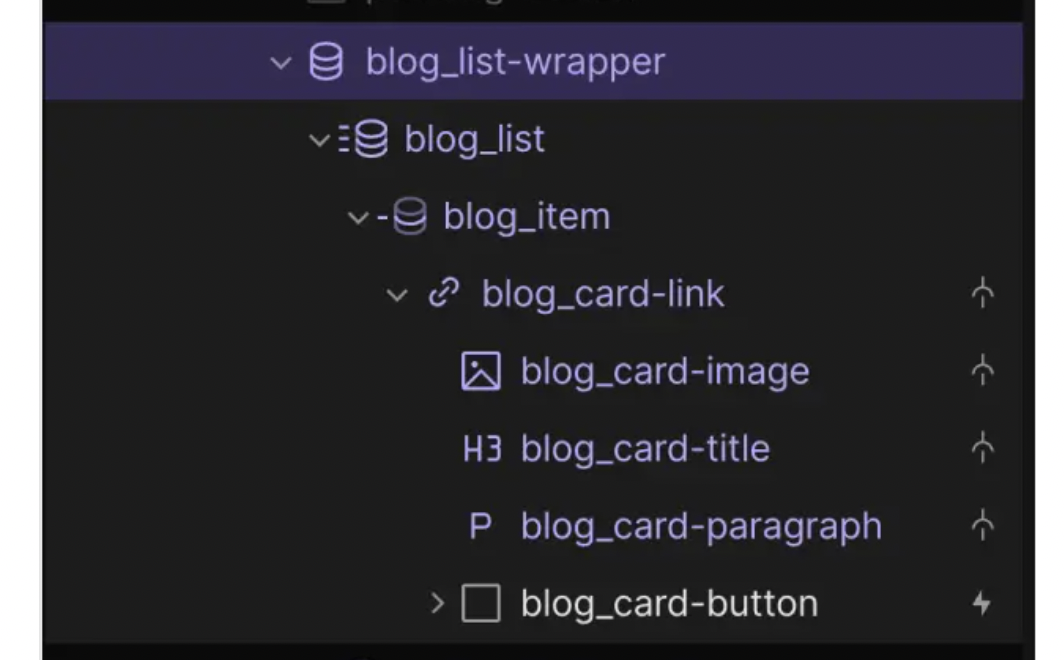
Elements and structure
- Use semantic HTML tags, like <header>, <main>, <footer>, <section>, etc.
- Every section should be a component, if possible.
- Every section should have these elements, which is simpler than Client-First:
- 1. Section element
- 2. Container element
- 3. Layout element
Custom code
- Use custom CSS only when necesarry.
- Contain any custom CSS in the Universal / Head item for easy access.
- Comment what custom CSS and JS does, in the code.
- Create extra functionality as components, add them to the "Universal / Body" slot.
- Make global changes in the Code / JS / Universal item.
- Use LLMs (ChatGPT, Claude, etc.) only for custom JS.
🔹 Technical SEO Checklist
Page Speed & Performance
☐ Optimize images and use modern formats (WebP, AVIF)
☐ Minify and optimize CSS and JavaScript
☐ Use lazy loading for images and videos
☐ Enable caching for faster load times
☐ Use a Content Delivery Network (CDN) for global performance
Mobile-Friendliness & Core Web Vitals
☐ Test mobile-friendliness in Google’s Mobile-Friendly Test
☐ Ensure all interactive elements are easy to use on mobile
☐ Optimize LCP, FID, and CLS for a good page experience
URL Structure & Canonicalization
☐ Keep URLs short, descriptive, and free of special characters
☐ Implement rel=canonical to avoid duplicate content
☐ Use simple and logical URL structures
Indexing & Crawling
☐ Submit an updated XML sitemap to Google Search Console
☐ Ensure important pages are crawlable (not blocked in robots.txt)
☐ Use "noindex" for irrelevant or duplicate pages
Structured Data (Schema Markup)
☐ Implement the correct schema types (Organization, FAQ, Product, etc.)
☐ Test structured data in Google’s Rich Results Test
HTTPS & Security
☐ Secure the website with a valid SSL certificate (HTTPS)
☐ Remove mixed content (HTTP resources on HTTPS pages)
☐ Load all external resources via HTTPS
Hreflang & Multilingual SEO
☐ Use hreflang to indicate correct language and region
☐ Ensure HTML lang attribute matches the page language
Open Graph & Social Sharing
☐ Define Open Graph tags (og:title, og:description, og:image)
☐ Test sharing in Facebook Debugger
Meta & Title Tags
☐ Each page has unique, descriptive titles with keywords
☐ Write engaging meta descriptions (max 160 characters)
ALT Text & Images
☐ All images have descriptive ALT text
☐ Exclude ALT text for decorative images
Internal Linking
☐ Optimize internal linking to strengthen key pages
☐ Remove broken links (404 errors)
404 Errors & Redirects
☐ Fix broken links and incorrect redirects
☐ Use 301 redirects for old URLs
Crawl Budget & Log Analysis
☐ Analyze Googlebot logs to monitor crawl patterns
☐ Block unnecessary pages in robots.txt
JavaScript & SEO
☐ Ensure important content is not hidden behind JavaScript
☐ Use server-side rendering (SSR) or pre-rendering if needed
Pagination & Infinite Scroll
☐ Use rel=next and rel=prev for paginated content
☐ Ensure infinite scroll content is crawlable
Faceted Navigation & URL Parameters
☐ Manage filtering systems to avoid duplicate content
☐ Block unnecessary URL parameters in Google Search Console
Hosting & Server Response
☐ Use a fast and reliable hosting provider
☐ Keep server response time (TTFB) under 200ms
🔹 On-Page SEO Checklist
Keyword Optimization
☐ Include the primary keyword naturally in title, headings, and body
☐ Use variations and related terms for richer content
☐ Include the main keyword within the first 100 words
Title Tags & Meta Descriptions
☐ Write unique and descriptive titles (30–60 characters)
☐ Create engaging meta descriptions (110–160 characters)
☐ Include a CTA or value proposition in title/meta description
Heading Structure (H1, H2, H3)
☐ Only one H1 per page, containing the main keyword
☐ Use a logical hierarchy (H2 for sections, H3 for subsections)
☐ Avoid overly long or generic headings
Content Quality & Relevance
☐ Content is original, informative, and valuable
☐ Each page has at least 300+ words (more for important pages)
☐ Use bullet points, lists, or tables for readability
Internal Linking
☐ Link to relevant internal pages with natural anchor text
☐ Ensure all internal links work (no 404 errors)
☐ Balance internal and external linking
External Links (Outbound Links)
☐ Link to authoritative external sources when relevant
☐ Open external links in a new tab (target="_blank")
Images & Multimedia
☐ Compress images for faster loading
☐ Use descriptive filenames (e.g., woodnest-cabin.jpg instead of IMG123.jpg)
☐ Add relevant ALT text for all images
URL Structure & Permalinks
☐ Keep URLs short, descriptive, and keyword-rich
☐ Avoid unnecessary parameters and stop words
☐ Use hyphens (-) instead of underscores (_)
Mobile-Friendliness & UX
☐ Ensure the page is responsive across all devices
☐ Buttons and text are easy to read and click on mobile
☐ Test with Google’s Mobile-Friendly Test
Core Web Vitals & UX
☐ LCP under 2.5 seconds
☐ Avoid large layout shifts (CLS)
☐ Optimize interactivity for low FID
Structured Data & Rich Snippets
☐ Add relevant schema markup (FAQ, Product, Article)
☐ Test schema with Google Rich Results Test
Call-to-Action & Conversion
☐ Add a clear CTA guiding users to the next step
☐ Ensure buttons and CTAs are visible and easy to click
Open Graph & Social Sharing
☐ Fill out Open Graph tags (title, image, description)
☐ Test display with Facebook Debugger
🔹 SEO for AI Engines (Generative Search & Answer Engines)
Structured & Machine-Readable Content
☐ Bruk omfattende schema markup (FAQ, HowTo, Article, Product, Organization)
☐ Lag tydelige Q&A-seksjoner som AI kan trekke direkte inn i svar
☐ Sørg for godt strukturerte lister, tabeller og punktvis innhold
Content Designed for AI Consumption
☐ Skriv kontekstualisert og forklarende innhold – AI belønner dybde og sammenheng
☐ Bruk naturlig språk og formuler svar på typiske bruker-spørsmål
☐ Produser long-form content med både detalj og sammendrag
Topical Authority & Trust
☐ Bygg autoritet innenfor spesifikke tema (topic clusters)
☐ Få backlinks fra relevante, troverdige kilder – også viktige for AI-modeller
☐ Sørg for høy EEAT-score (Experience, Expertise, Authoritativeness, Trustworthiness)
Multimodal Optimization
☐ Optimaliser bilder og video med beskrivende metadata – AI-motorer tolker dette
☐ Legg til transkriberte tekster på videoer og podcaster
☐ Tilby innhold i flere formater (tekst, bilde, video, lyd)
Brand & Entity Recognition
☐ Bruk structured data for å definere selskapet/produktet ditt som en “entitet”
☐ Sørg for konsistent omtale av brandet på tvers av kanaler
☐ Jobb aktivt for mentions i nyheter, blogger og sosiale medier (uten nødvendigvis lenke)
User Intent & Answer-Focused Copy
☐ Optimaliser for spørsmål og svar (Who, What, Where, Why, How)
☐ Lag dedikerte FAQ-sider og “People Also Ask”-stil innhold
☐ Sørg for at innholdet ditt kan gi et kort, klart og direkte svar
Monitoring & AI-Specific Tools
☐ Test hvordan innholdet vises i Perplexity, Bing Copilot, ChatGPT Browse/Plugins
☐ Overvåk brand mentions i AI-svar (nye verktøy som Nozzle AI og Perplexity Rank Tracker)
☐ Juster strategi basert på hvilke sider som faktisk blir brukt i AI-svar